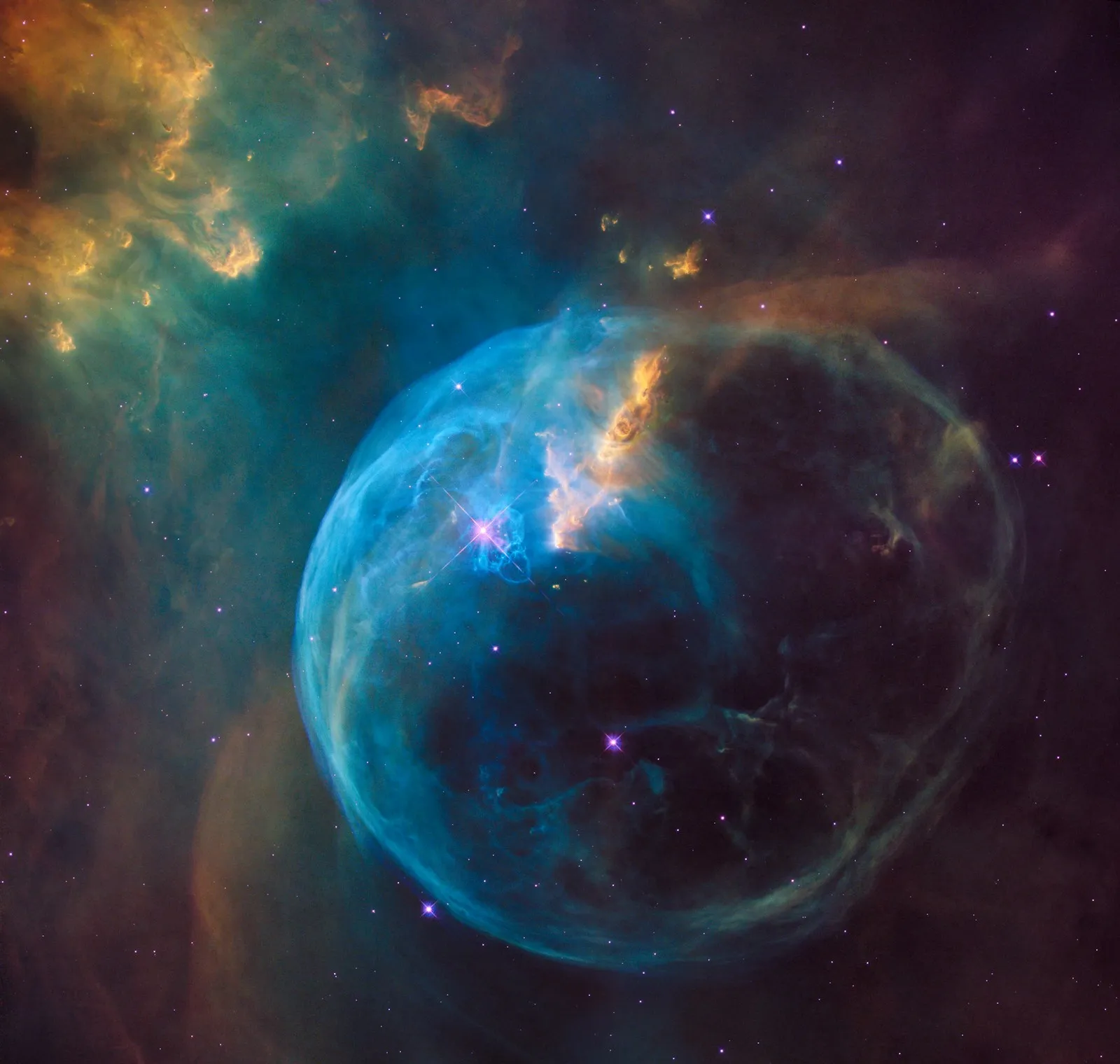

Four and a half billion years ago, a cloud of gas and dust collapsed under its own gravity, flattened into a spinning disk, and began the process that would eventually produce the Sun, the Earth, and everything on it. We have known this story for over a century. What we have never had, until now, is a picture of it happening somewhere else — in detail fine enough to see the individual gaps where planets are beginning to clear their orbits.
The image, released by an international collaboration using a new generation of millimeter-wave interferometry, shows a young star in the Taurus molecular cloud, roughly 450 light-years away. The star is perhaps two million years old — a newborn, cosmically speaking — and the disk surrounding it is already structured: concentric rings of dust interrupted by dark gaps that mark where forming planets have swept their orbital paths clean.
What the image shows
The resolution achieved is equivalent to distinguishing two objects separated by the width of a human hair from a kilometer away. At that scale, the disk reveals features that models predicted but had never been directly observed: a dense inner ring of silicate dust, an outer ring rich in carbon compounds, and three distinct gap-ring pairs that correspond closely to the predicted orbital periods of Earth-mass bodies.
One gap, at a distance from the star roughly equivalent to Jupiter’s distance from the Sun, is wider than expected — suggesting either a more massive planet, or two smaller planets in orbital resonance clearing a shared path.
Why it matters
Planet formation models have been tested against our own solar system, but our solar system is a single data point. Every protoplanetary disk imaged in detail adds a new constraint. This one, with its three gaps and its unexpectedly wide outer clearing, already challenges one class of formation models and supports another.
The team plans to observe the system again in five years. At the pace of planet formation, five years is nothing. But the instruments will be sharper, and the questions will be better.