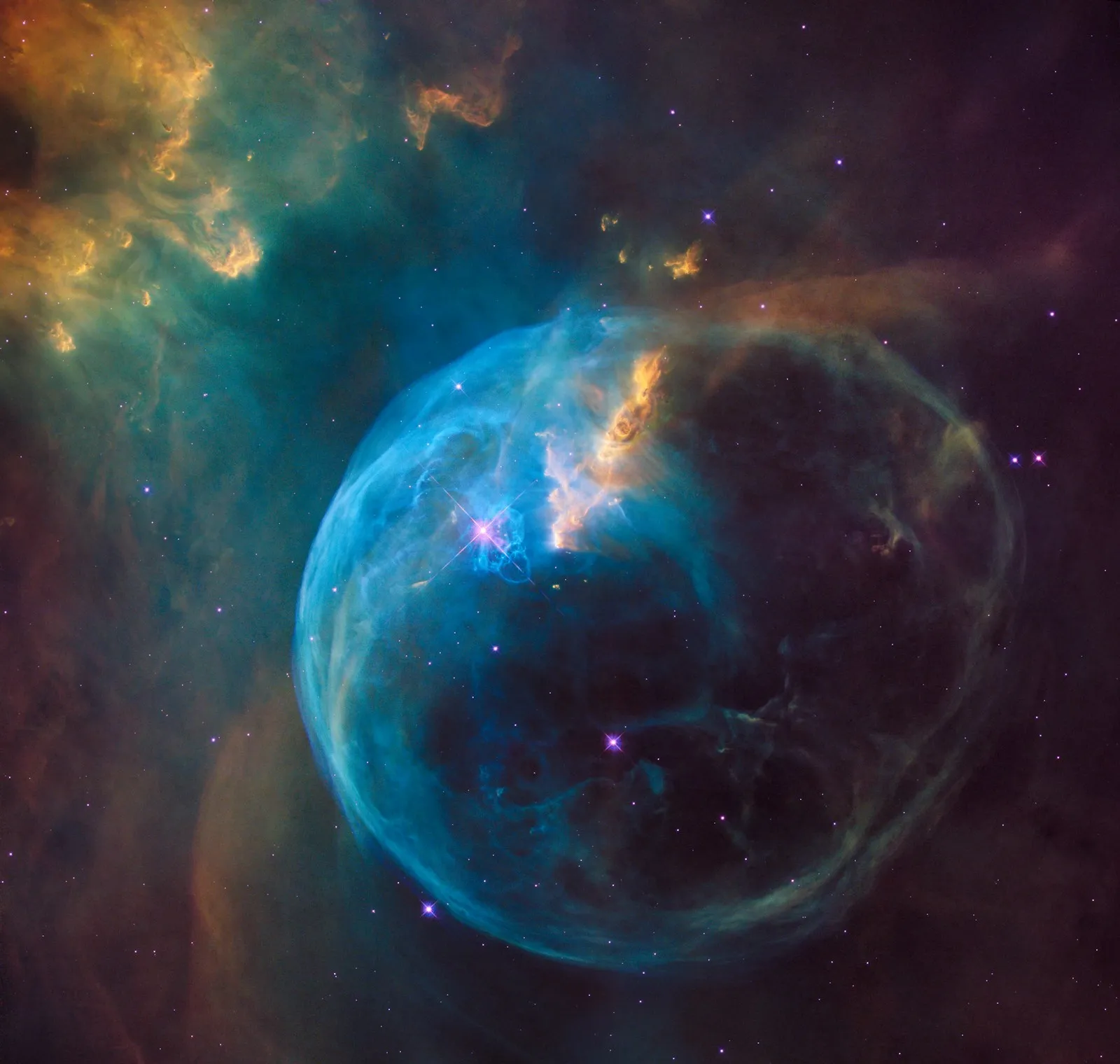

The light now arriving at our telescopes from the galaxy designated MRK-2026-A left its source when the universe was 300 million years old. The universe is now 13.8 billion years old. That light has been traveling for 13.5 billion years, and what it shows — a compact knot of stars already burning with the luminosity of several billion suns — is a galaxy that should not have had time to exist.
The discovery, confirmed by spectroscopic follow-up using three independent instruments, pushes the record for the most distant confirmed object by roughly 80 million light-years beyond the previous holder.
The measurement
Confirming a record like this requires more than a photograph. The distance to a galaxy is inferred from its redshift — the degree to which the expansion of the universe has stretched its light toward longer, redder wavelengths. A photometric redshift, estimated from colors alone, is often enough for a first identification. A spectroscopic redshift, which splits the galaxy’s light into its component wavelengths and matches specific features to known atomic signatures, is the confirmation.
MRK-2026-A’s spectroscopic redshift of z = 14.4 places it comfortably beyond any previously confirmed galaxy. Three emission lines — hydrogen Lyman-alpha, carbon, and oxygen — were detected at wavelengths that match exactly what those lines should show at that distance.
What it tells us
The galaxy is not just far; it is unexpectedly bright and unexpectedly massive for its age. Estimates of its stellar mass — inherently uncertain at this distance — suggest it contains at least 400 million solar masses of stars. That much stellar mass, assembled in 300 million years, requires a star formation rate that strains current models.
It is one object. Science cannot overturn a model on a single observation. But it is a very strange single observation, and the people who built those models are now revising their numbers.